
Here’s the dirty secret that anyone being honest about AEO has to acknowledge: measuring it is genuinely hard. Not impossible — but harder than measuring paid search clicks, harder than tracking organic keyword rankings, harder than attributing revenue to a specific campaign. The standard marketing analytics stack was not built for a world where potential customers encounter your brand in an AI-generated answer and then, sometime later, find their way to your website or pick up the phone.
This measurement gap is one of the main reasons sophisticated brands have been slow to invest in AEO. It’s uncomfortable to invest significantly in a channel where the ROI case is less clean than a well-instrumented paid search account.
But the measurement problem is solvable. It requires different approaches than traditional digital analytics — but brands that build the right tracking infrastructure can make a compelling, evidence-based case for AEO’s contribution to revenue.
The Attribution Challenge (And Why It’s Not Unique to AEO)
First, some important perspectives. The attribution problem for AEO is real, but it’s not unique to AEO. Brand advertising, PR, content marketing, thought leadership events — all of these have attribution challenges. We accept that they contribute to pipeline and revenue without being able to cleanly attribute specific revenue to specific placements, because the logic of how they work is clear even when the direct measurement isn’t.
AEO sits in the same category. Someone encounters your brand in an AI answer while researching a problem. They don’t immediately click through. They mentally file your brand as worth investigating. A week later, they Google your name directly. They find your website, like what they see, fill out a contact form. In your analytics, this shows up as a branded search lead. AEO’s contribution is invisible — but it was real.
Understanding this attribution structure is the starting point for AEO measurement. The channel does generate leads and revenue. It’s just upstream of the directly trackable touchpoints in most standard analytics configurations.
Branded Search Volume as an AEO Proxy Metric
One of the most practical early indicators of AEO effectiveness is branded search volume. When your brand starts appearing regularly in AI answers for relevant queries, people start searching for your brand name directly — because they heard about you from an AI and want to find out more. That shows up as branded search volume in your analytics.
Branded search is already considered a high-quality signal in digital marketing — it represents high-intent, self-motivated discovery. Tracking branded search volume over time, segmented by geographic markets and customer segments, gives you a meaningful proxy for the awareness impact of AEO.
This isn’t a perfect attribution. But it’s real, trackable, and directionally useful. If your branded search volume grows materially in a market where you’ve done focused AEO work, while remaining flat in a comparable market where you haven’t, that’s evidence of contribution.
AEO services pricing conversations with agencies should include this metric framework explicitly — any AEO partner worth working with should be able to show you how they plan to demonstrate impact through trackable proxies like branded search volume, not just AI answer audit reports.
Direct AI Mention Tracking
Several emerging tools now allow brands to systematically monitor when and how they’re mentioned in AI-generated answers across major platforms. This is an AEO analog to brand mention monitoring in traditional media — it tells you whether your AEO efforts are translating into actual AI answer inclusion, and with what frequency and in what contexts.
Building an AI mention tracking cadence — regular, systematic queries across ChatGPT, Perplexity, Google AI Overviews, and other relevant platforms — gives you a direct measure of AI answer presence. Over time, you can track whether your share of mentions in relevant query categories is growing, and whether the context of those mentions is becoming more favorable.
This is not revenue attribution. But it’s a leading indicator that’s directly connected to the strategy. If AI mention frequency is growing in your target query categories, that’s AEO working. The downstream revenue effects follow — with a lag, and through the indirect attribution pathways described above.
Building the Full Measurement Case
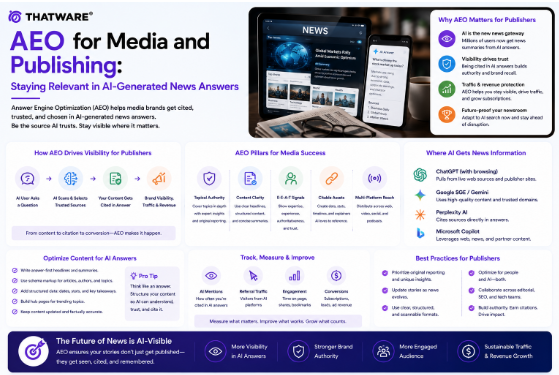
The most credible AEO measurement approaches combine several data streams: AI mention tracking (direct), branded search trend analysis (proxy), website traffic source analysis (looking for the patterns associated with AI-referred visitors), and customer research (surveying new customers about how they first encountered your brand).
That last one is underutilized. Simply asking new customers “how did you first hear about us?” is still useful data, and an increasing number of people will answer “I saw your name come up when I was asking an AI about X.” That qualitative data, tracked systematically over time, gives you a direct window into AEO’s contribution to your customer acquisition pipeline.
The brands that invest in building this multi-signal measurement infrastructure now will be in a much stronger position to make the ROI case for AEO as the channel matures. Working with a best AEO agency that has thought carefully about measurement and can build this tracking infrastructure alongside the strategy is one of the clearest differentiators between agencies that are doing serious work and those that are not.
AEO without measurement is just hope. AEO with a thoughtful measurement framework is a manageable, improvable, justifiable investment — even in organizations that demand hard ROI on marketing spend.
