
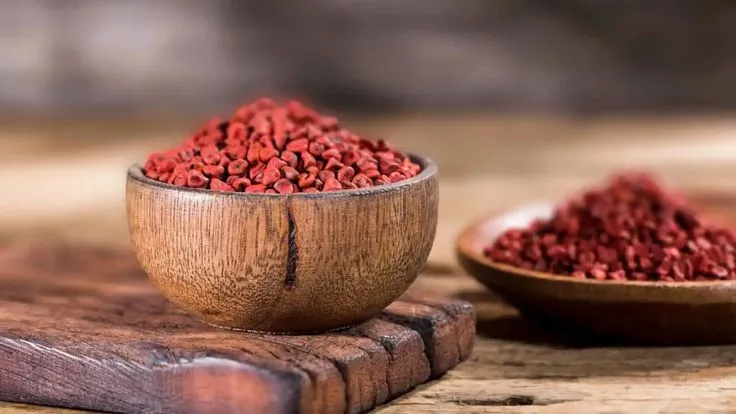
Color is one of the first things people notice about a food product, but getting it right can take more work than expected. A developer looking for an annatto food color, for example, is not simply choosing between “yellow” and “orange.” The formula, processing temperature, pH, fat content, and final appearance all influence whether annatto will perform well.
Natural colors have their own strengths, and two ingredients that sit close together on a color chart can act differently in a finished product. Annatto and turmeric are a good example. Both can create warm shades, yet they do not solve exactly the same formulation problems.
Annatto Has More Than One Form
Annatto comes from the seeds of Bixa orellana. Its main coloring pigments are bixin and norbixin. That distinction matters because bixin is associated with oil-soluble systems, while norbixin can be used in water-soluble applications.
FoodRGB lists annatto in powder, liquid, oil, and custom formulations. Its annatto page notes a pH range of about 5.0 to 10.0 and highlights heat stability. Those characteristics can make annatto useful in cheese, dairy foods, baked goods, snacks, seasonings, confectionery, and selected beverages.
The shade can move from yellow toward orange depending on the form, concentration, and food system. That gives developers room to adjust appearance without treating annatto as a single fixed color.
Turmeric Brings a Different Yellow
Turmeric is better known as a spice, but its color comes mainly from curcumin. In food manufacturing, refined turmeric or curcumin color can be used when a bright yellow is wanted.
FoodRGB offers turmeric color in powder, liquid, oil, and custom formats. The company lists applications including baked goods, snacks, frozen beverages, confectionery, seasonings, pickled vegetables, functional beverages, and crackers. Its product information places turmeric performance in roughly the pH 3.0 to 7.0 range.
For a company speaking with a turmeric extract manufacturer, the useful questions go beyond pigment strength. Is the product acidic? Does the formula need a water-based or oil-based version? Will the color go through heating before packaging? Those details can change which turmeric formulation makes sense.
Do Not Choose by Shade Alone
It is easy to place annatto and turmeric beside each other because both can create yellow tones. Still, they should not be treated as interchangeable ingredients.
A cheese formula may benefit from an oil-soluble annatto system because fat is an important part of the product. An acidic beverage may lead a developer to explore a turmeric formulation designed for that environment. The decision comes down to compatibility, not which ingredient sounds more familiar.
The same idea applies to concentration. A strong color is not automatically a better color. Too much pigment can produce a shade that looks heavy or out of character. Small bench trials usually reveal more than simply increasing the dose.
Watch What Happens After Processing
Fresh color tells only part of the story. A useful trial should also show how the product looks after heating, cooling, freezing, or whatever processing step it normally goes through.
Storage deserves attention as well. Light exposure, oxygen, packaging, and time can all change appearance. A sample that looks right on day one may not be the best option several weeks later. Testing around the real commercial process gives developers a more useful picture than an ideal lab sample.
Scaling up can expose new issues too. Mixing is different in a large production tank, and small variations in raw materials may become more noticeable across bigger batches.
A Better Way to Compare Options
Instead of asking which natural yellow color is “best,” formulators can ask which one fits the product most comfortably. That means comparing solubility, pH, heat exposure, storage conditions, target shade, and production method together.
Annatto may be the better fit in one application, while turmeric may make more sense in another. Custom formulation work can also help close the gap between the desired appearance and what a standard ingredient delivers.
Conclusion
Natural yellow and orange colors are easier to work with when the food itself guides the choice. Annatto offers flexible bixin- and norbixin-based options, while turmeric provides curcumin-based yellow solutions for a different range of formulation conditions. Manufacturers can use foodrgb.com to explore these color systems, review application options, and connect with technical support for product-specific requirements. The most useful color is not simply the brightest one in a sample; it is the one that still looks right after processing, storage, and full-scale production.
